
Search is evolving faster than ever before.
For years, businesses focused heavily on traditional SEO to improve rankings on Google and drive organic traffic. But today, artificial intelligence is transforming how people search online.
Users are no longer relying only on traditional search engines. They are increasingly using:
- ChatGPT
- Google AI Overviews
- Gemini
- Bing AI
- Voice assistants
- AI-powered search platforms
Instead of browsing through multiple websites, users now expect direct answers within seconds.
This shift is changing the future of digital marketing.
And that is where GEO – Generative Engine Optimization – enters the conversation.
Businesses investing in modern SEO Services are already adapting to this new AI-powered search landscape.
What Is SEO?
SEO stands for Search Engine Optimization.
Traditional SEO focuses on improving a website’s visibility on search engines like Google through:
- Keywords
- Content optimization
- Backlinks
- Technical SEO
- Website structure
- User experience
The main goal of SEO is simple:
Help websites rank higher on search engine result pages.
For years, SEO has helped businesses generate:
- Organic traffic
- Leads
- Brand awareness
- Website authority
- Sales opportunities
When users search for information, Google displays website links based on relevance and quality. Businesses that optimize effectively rank higher and attract more visitors.
ModernDigital Marketing strategies still rely heavily on SEO because search visibility remains essential for online growth.
[H2] What Is GEO?
GEO stands for Generative Engine Optimization.
Unlike traditional SEO, GEO focuses on optimizing content for AI-powered search systems and conversational AI platforms.
Platforms like:
- ChatGPT
- Google AI Overviews
- Gemini
- Claude
- Bing AI
now provide direct AI-generated answers instead of simply displaying website links.
These AI systems summarize information, answer questions conversationally, and recommend businesses directly to users.
This changes how businesses gain visibility online.
Instead of only ranking websites, businesses must now optimize content to become trusted sources AI systems choose when generating responses.
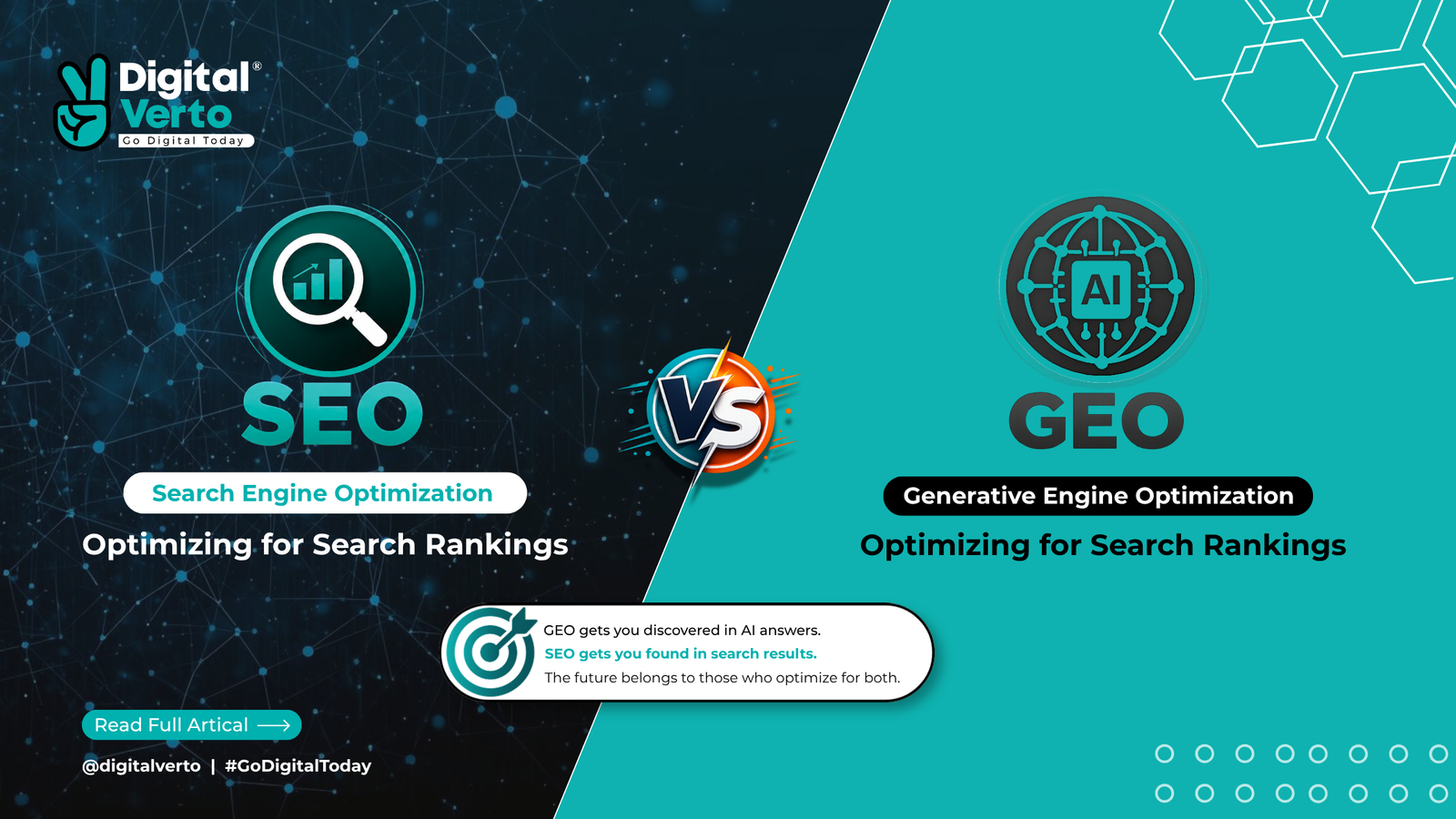
GEO vs SEO: What Is The Difference?
Traditional SEO focuses on helping users discover websites.
GEO focuses on helping AI systems discover trusted answers.
SEO focuses on:
- Search rankings
- Organic traffic
- Keywords
- Website optimization
- Backlinks
GEO focuses on:
- AI-generated visibility
- Conversational relevance
- Helpful content
- Contextual understanding
- Brand authority
In simple words:
SEO helps users find your website.
GEO helps AI recommend your business directly.
That is why businesses now need both strategies together instead of relying on only traditional SEO methods.
Why GEO Is Becoming More Important
Search behavior is changing rapidly because users want:
- Faster answers
- Personalized recommendations
- Conversational experiences
- Simplified information
People are increasingly asking complete questions like:
“What is the best digital marketing strategy for small businesses?”
instead of searching with short keywords.
AI-powered search systems understand intent more naturally and generate direct answers instantly.
This means businesses can no longer focus only on keyword rankings.
They must also focus on:
- Authority
- Trust
- Helpful content
- Brand reputation
- Conversational optimization
Strong Branding Agency strategies now play a major role in AI visibility because AI systems often prioritize trusted and recognizable brands.
How Businesses Can Optimize For GEO
Businesses that want to succeed in AI-powered search should focus on creating genuinely valuable content.
1. Create Helpful Content
AI systems prioritize content that solves real user problems clearly and naturally.
2. Use Conversational Language
Write content the way people actually speak and ask questions.
3. Build Authority
Consistently publish high-quality content related to your niche.
4. Improve Trust Signals
Reviews, backlinks, mentions, and customer reputation help AI systems trust your business.
5. Strengthen Brand Visibility
Recognizable brands are more likely to appear inside AI-generated recommendations.
Businesses investing in professional Content Marketing strategies often improve both traditional SEO rankings and AI-generated discoverability.
Technical SEO Still Matters
Even though AI-powered search is growing, technical SEO remains extremely important.
Your website should still:
- Load quickly
- Be mobile-friendly
- Use HTTPS security
- Have clean navigation
- Include schema markup
- Offer strong user experience
AI systems still rely on well-optimized websites to understand business information accurately.
A professionally optimized Web Development structure improves both user experience and AI search visibility.
Social Media & Brand Presence Influence AI Search
AI search systems analyze more than just websites.
They also evaluate:
- Social media presence
- Brand mentions
- Customer reviews
- Online engagement
- Content consistency
Businesses with active digital presence usually appear more trustworthy online.
Consistent Social Media Marketing helps businesses stay visible, improve engagement, and strengthen brand authority across modern search ecosystems.
The Future Of Search Optimization
The future of search is becoming:
- More conversational
- More AI-driven
- More personalized
- More intent-focused
Search engines are evolving from:
“Showing website links”
to: “Providing direct answers.”
This transformation is changing how businesses approach:
- SEO
- Content marketing
- Branding
- User experience
- Online visibility
Businesses that adapt early to GEO and AI-powered optimization will gain stronger visibility and customer trust in the coming years.
Frequently Asked Questions
What is GEO in digital marketing?
GEO stands for Generative Engine Optimization, which focuses on optimizing content for AI-powered search engines and conversational AI systems.
What is the difference between GEO and SEO?
SEO focuses on improving website rankings, while GEO focuses on improving visibility inside AI-generated search responses.
Is traditional SEO still important?
Yes. Technical SEO, content quality, and website optimization remain essential even as AI-powered search grows.
Why is GEO becoming popular?
Because more users are relying on AI-powered platforms like ChatGPT, Gemini, and Google AI Overviews for direct answers and recommendations.
Can businesses use SEO and GEO together?
Absolutely. The strongest digital strategy combines both SEO and GEO to maximize visibility across traditional and AI-driven search platforms.
SEO transformed digital marketing for decades.
Now GEO is beginning to shape the future of online search.
Traditional SEO still remains essential for rankings, visibility, and website performance. But AI-powered search is changing how customers discover businesses online.
The future belongs to businesses that combine:
- SEO
- GEO
- Helpful content
- Branding
- Authority building
- Conversational optimization
Because modern search engines are no longer simply ranking websites.
They are recommending trusted brands.
And businesses that become trusted answers will dominate the future of search optimization.
At Digital Verto, we help brands grow with both:
GEO (Generative Engine Optimization) for AI-powered visibility across platforms like ChatGPT, Gemini, Perplexity, and Google AI Overviews
SEO (Search Engine Optimization) for Google rankings and organic traffic